Route Planner
Overview
The Route Planner panel helps you calculate optimal travel paths between systems—either through jump gates or mapped wormholes. It includes:
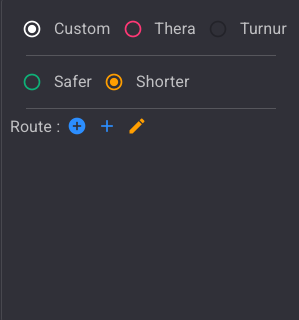
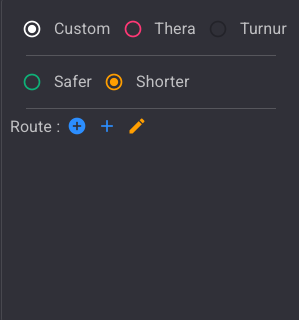
- A route type selector (Custom, Thera, Turnur).
- A path preference selector (Safer / Shorter).
- Action buttons for managing your route list.
- A dynamic list of destination systems with jump counts.
- Automatic pathfinding based on wormhole and gate connections.
If a system is selected and has a valid route (gate or mapped wormhole), the planner automatically calculates the best path based on your preferences.
By default, the planner uses the Custom route type and the Shorter path preference.
Route Type
The route type determines which connections are factored into the pathfinding algorithm.
| Type | Description |
|---|---|
| Custom | WHMapper's own algorithm using K-space stargates and mapped wormhole connections. |
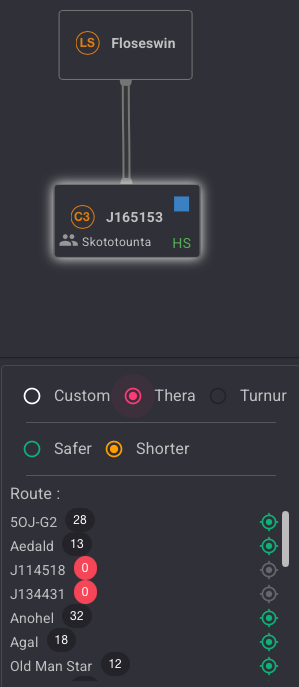
| Thera | Extends the Custom algorithm by incorporating Thera's daily public K-space wormhole connections, potentially offering shorter routes through known space. |
| Turnur | Extends the Custom algorithm by incorporating Turnur triglavian connections. |
Example — Thera, Shorter mode (from J165153):
Example — Thera, Safer mode (from J165153):
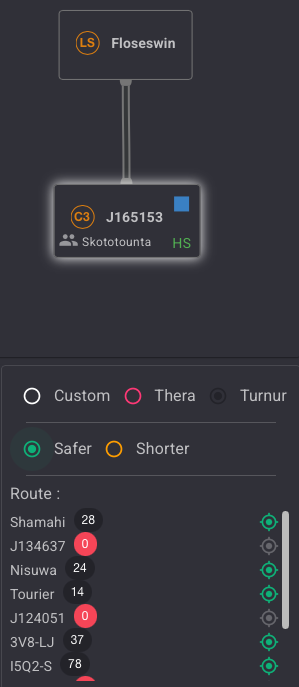
Thera and Turnur connections are sourced dynamically. Jump counts may vary as those connections change throughout the day.
Action Buttons
The action buttons vary depending on your user role.
Admin View
As an administrator, you can define a global list of key systems (e.g., Jita, Amarr). These will be visible to all characters with access to the map.
User View
As a primary character, you can still create your own custom system list, in addition to those defined by admins.
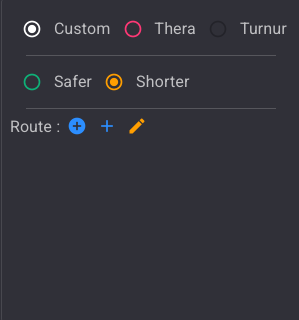
If you have linked several EVE characters to your session (see Authenticate → Multiple Characters), any route entry you add — regardless of which character is currently active — is recorded under your primary character. The same rule applies to signature imports and notes.
Add a System
To add a system to your route list:
-
Click the Add button:
- Admin:

- User:

- Admin:
-
The system search dialog appears:

-
Start typing the name of the system (e.g.,
Jita):
 tip
tipEnter at least 3 characters — the list will update in real time.
-
Click Add System to confirm. Systems are added to your list with a jump count of 0 until a map system is selected.
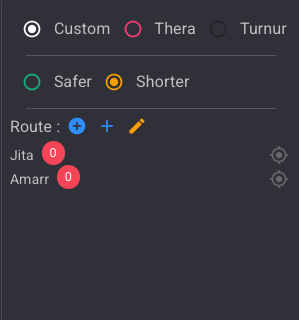
Click Cancel to close without adding.
Edit a System
To modify your route list:
- Click the Edit button:

Once enabled, a delete icon will appear next to each entry.
- Admins can remove both global and personal systems.
- Primary characters can only delete systems they personally added (i.e. systems recorded under their primary character).
Admin View

User View

Delete a System
To remove a system from your list:
-
Click the delete icon beside the system:

-
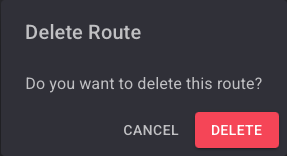
Confirm the action in the dialog:
Automatic Path Calculation
How It Works
- Select a system on the map.
- The planner calculates jump distances between the selected system and each listed destination, according to the Route Type and path preference (Shorter / Safer).
When a Route Exists
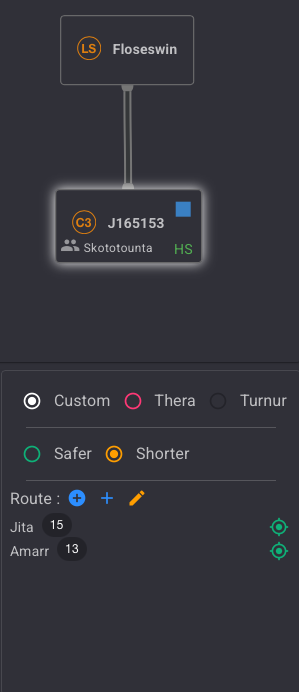
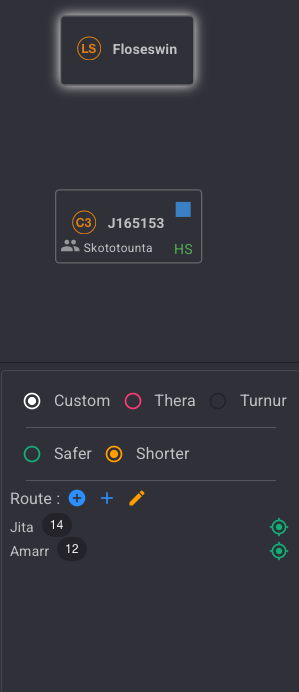
If a route is found, the number of jumps appears next to each destination, accompanied by a green indicator icon.
Routes can be:
- Fully mapped wormhole connections.
- Standard stargate paths.
- Thera or Turnur connections (when the corresponding route type is selected).
Examples:
-
Via wormhole (from J165153):
-
Via K-space gates (from Floseswin):
When No Route Exists
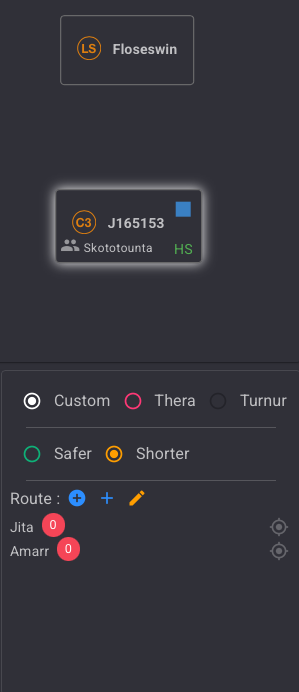
If no path is found, the jump count will show 0 with a red indicator icon.
This can happen if:
- The selected system is a wormhole with no mapped connections to reach the destination.
- A listed system is isolated from the current network.
Example:
Display a Route Path on the Map
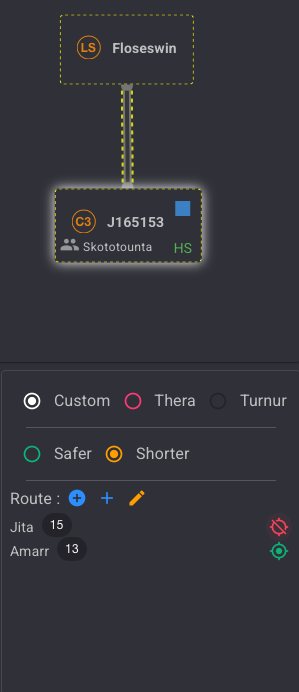
You can visually display the route path (highlighted in yellow) between the selected system and any destination in your list.
Only mapped systems are shown in the path on the map.
Unmapped K-space hops are not visualized even if the route technically passes through them.
Toggle Path Display
-
To show a path:
Click this icon beside the system:
-
To hide the path:
Click the same icon again:
Route Path Tooltip
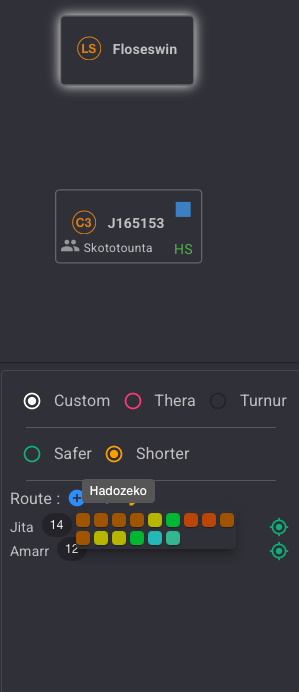
When hovering over the destination system icon, a tooltip displays the complete route path — listing every system you need to travel through to reach your destination.
Each system in the tooltip is represented by a color-coded dot matching the security status.